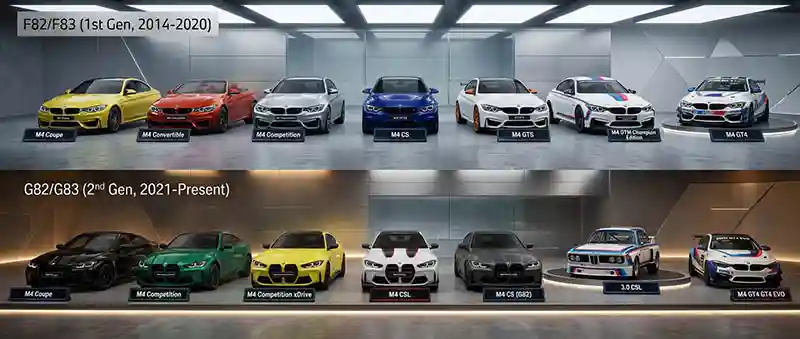
The BMW M4 evolution is one of the most interesting stories in BMW M history. Unlike the BMW M3, which traces its roots back to the legendary E30 M3 of the 1980s, the M4 nameplate itself is relatively young. The BMW M4 officially appeared in 2014, when BMW separated the high-performance two-door models from the M3 lineup and gave them a new identity.
But the story does not really begin in 2014.
To understand the evolution of the BMW M4, you have to look at the high-performance BMW coupés that came before it, particularly the E36 M3, E46 M3 and E92 M3. These cars established the formula that eventually became the M4: a compact rear-wheel-drive platform, a high-performance straight-six or V8 engine, aggressive chassis tuning, motorsport-inspired aerodynamics and a strong connection between road-car usability and track performance.
From the first F82 M4 to today’s G82 M4 Competition, M4 CSL and M4 CS, the formula has changed considerably. Naturally aspirated engines gave way to turbocharging, traditional rear-wheel drive was joined by M xDrive, manual transmissions remained available in selected configurations, and carbon fiber became increasingly important to controlling weight and improving vehicle dynamics.
So, how has the BMW M4 evolved?
This guide covers the complete BMW M4 evolution, including its origins, F82 and F83 models, Competition variants, M4 GTS, M4 CS, the second-generation G82/G83, M4 CSL, M4 CS, 2024 updates, engines, performance, design and the major technical changes between generations.
If you are interested in BMW carbon fiber parts, feel free to contact us for a quote. As a professional manufacturer of carbon fiber automotive parts, we serve wholesalers and distributors while also offering customized OEM/ODM services.
BMW M4 Evolution at a Glance
Before looking at each model in detail, it helps to understand the overall timeline.
| BMW M4 generation / version | Production / introduction | Engine | Maximum output | Key development |
|---|---|---|---|---|
| F82 M4 | 2014–2020 | 3.0L S55 twin-turbo inline-six | Up to 450+ hp depending on version | First model officially called M4 |
| F83 M4 Convertible | 2014–2020 | 3.0L S55 twin-turbo inline-six | Up to 450+ hp depending on version | First M4 convertible |
| M4 GTS | 2016 | 3.0L S55 twin-turbo inline-six | 500 hp | Water injection, lightweight construction |
| M4 CS | 2017–2018 | 3.0L S55 twin-turbo inline-six | 460 hp | Track-focused limited edition |
| G82 M4 | 2020–present | 3.0L S58 twin-turbo inline-six | Up to 530 hp in current Competition xDrive | Second-generation M4 |
| G83 M4 Convertible | 2021–present | 3.0L S58 twin-turbo inline-six | Up to 530 hp | M xDrive and soft-top convertible |
| M4 CSL | 2022 | 3.0L S58 twin-turbo inline-six | 550 hp | Lightweight, rear-wheel-drive track-focused model |
| M4 CS | 2024–present | 3.0L S58 twin-turbo inline-six | 550 hp | 550-hp road-and-track configuration |
| Updated M4 Competition xDrive | 2024–present | 3.0L S58 twin-turbo inline-six | 530 hp | Updated styling and increased output |
The numbers alone show how dramatically the M4 has developed. The first F82 M4 introduced a turbocharged six-cylinder engine into the newly named M4 family, while the latest G82 Competition xDrive produces 530 hp. BMW’s M4 CSL and M4 CS push the S58 engine to 550 hp.
But the most important changes aren’t simply horsepower figures.
The BMW M4 evolution is really a story of changing engineering priorities: power, weight, traction, aerodynamics, chassis control and the balance between daily usability and circuit performance.
Where Did the BMW M4 Come From?
The BMW M4 did not appear out of nowhere.
For decades, BMW had used the M3 name for high-performance versions of both the sedan and two-door models based on the 3 Series. The E30, E36, E46 and E9x generations established the M3 as one of the defining performance cars in the premium compact segment.
The most important predecessor for the M4 was the E92 M3.
The E92 M3 used a naturally aspirated 4.0-liter V8 producing around 414 hp in U.S. specification, with an exceptionally high 8,400-rpm redline. It represented the peak of BMW’s naturally aspirated V8 approach before the company changed direction.
When BMW developed the next generation, it made two major decisions.
First, BMW returned to a straight-six engine.
Second, BMW separated the coupe and convertible from the M3 name.
The sedan remained the M3, while the coupe and convertible became the BMW M4.
BMW itself describes the 2014 F80 M3 and F82 M4 as a major transition point: the M3/M4 family introduced M TwinPower Turbo technology, bringing turbocharging to the series for the first time.
This means the M4 was simultaneously:
- a new nameplate;
- the successor to the M3 coupe;
- the successor to the M3 convertible;
- and the beginning of a new turbocharged era for BMW’s compact M cars.
That distinction is important when discussing BMW M4 evolution.
The M4 has only had two fundamental generations so far, but within those generations BMW has created a large number of performance variants and technical updates.
F82 BMW M4: The Beginning of the M4 Era
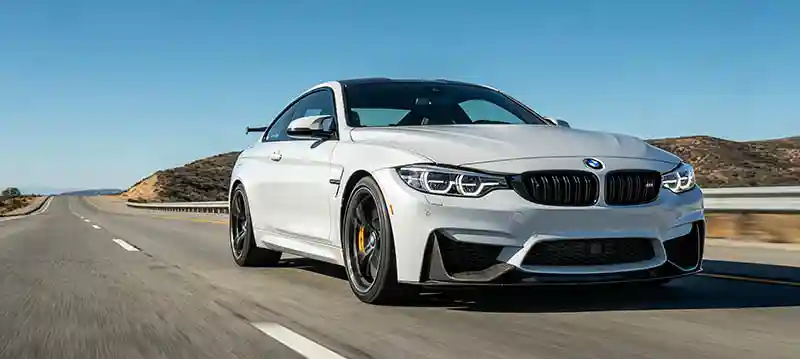
2014–2020 BMW M4 F82
The F82 BMW M4 is the first production car to officially carry the M4 name.
It was introduced in 2014 alongside the F80 M3, with the sedan retaining the M3 name while the coupe received the new M4 designation. The convertible was designated F83.
This was more than a naming exercise.
BMW wanted to create clearer separation between the 3 Series and 4 Series families. The M4 therefore became the high-performance flagship of the 4 Series coupe range.
Under the hood was BMW’s S55 engine: a 3.0-liter twin-turbocharged inline-six.
That represented a major departure from the naturally aspirated 4.0-liter V8 used by the previous-generation E92 M3.
F82 M4 Engine
The S55 engine was developed specifically for the high-performance M3 and M4 family.
Compared with the E92 M3’s naturally aspirated V8, the F82’s turbocharged inline-six focused more heavily on torque delivery and efficiency while retaining the characteristic BMW straight-six configuration.
The early F82 M4 produced approximately:
- 3.0-liter inline-six
- Twin turbochargers
- 425 hp
- 406 lb-ft of torque
- Rear-wheel drive
- Six-speed manual or seven-speed dual-clutch transmission depending on configuration
BMW’s official historical material identifies the F80 M3/F82 M4 as the first M3/M4 generation to use turbocharging.
The change was significant.
The E92 M3 needed high engine speeds to extract its performance from the naturally aspirated V8. The F82 M4, by contrast, used turbocharging to produce substantially more low- and mid-range torque.
That gave the M4 a very different character.
Instead of building performance primarily through engine speed, BMW could deliver strong acceleration much earlier in the rev range.
F82 M4 Design and Aerodynamics
The first M4 also established several visual themes that would become standard for future M4 models.
The body was significantly more aggressive than the standard 4 Series.
Key elements included:
- wider front and rear proportions;
- large air intakes;
- M-specific front bumper;
- sculpted hood;
- aerodynamic side mirrors;
- extended side skirts;
- rear diffuser;
- quad exhaust outlets;
- carbon-fiber roof on the coupe.
The carbon-fiber roof was particularly important.
Rather than treating carbon fiber simply as a styling material, BMW used CFRP as an engineering tool to reduce weight higher up on the vehicle and lower the center of gravity.
That philosophy would become even more important in later M4 models.
BMW M4 Competition: More Than a Power Upgrade
One of the most important developments during the F82 era was the introduction of the M4 Competition.
BMW used the Competition package to move the M4 closer to the track without completely sacrificing everyday usability.
The Competition specification increased engine output and introduced chassis and handling improvements.
Depending on model year and market, the Competition version reached approximately 450 hp.
The package also focused on:
- suspension tuning;
- active differential calibration;
- exhaust character;
- wheels and tires;
- aerodynamic details;
- steering response;
- and overall chassis balance.
This established a naming strategy BMW would later expand dramatically.
The standard M4 became the performance baseline.
The Competition became the more aggressive road-and-track option.
And eventually, BMW introduced CS and CSL models above it.
That hierarchy is essential for understanding the later G82 BMW M4 evolution.

BMW M4 GTS: The Extreme F82
2016 BMW M4 GTS
If the standard F82 established the M4 formula, the BMW M4 GTS showed how far BMW M could push it.
Introduced in 2016, the M4 GTS was designed as a technology demonstrator with serious track capability.
The most famous technical feature was its water-injection system.
BMW increased the S55 engine’s output to approximately 500 hp and 600 Nm. The car could accelerate from 0–100 km/h in 3.8 seconds and reach a limited top speed of 305 km/h.
But the engine was only one part of the story.
The M4 GTS also incorporated:
- extensive lightweight construction;
- carbon-fiber components;
- M Carbon Ceramic Brakes;
- optimized aerodynamics;
- track-focused suspension;
- special wheels and tires;
- OLED rear lights;
- aggressive aerodynamic components.
BMW reported a Nürburgring Nordschleife lap time of 7:28 for the M4 GTS.
This car demonstrated an important principle that would later define the CSL:
BMW increasingly focused on the complete vehicle — power, mass, braking, aero, tires and chassis control.
BMW M4 CS: Bridging Road and Track
2017–2018 BMW M4 CS
The BMW M4 CS followed the M4 GTS and occupied a slightly different position in the F82 lineup.
Instead of creating an extreme track-only-focused interpretation, BMW positioned the CS as a balance between everyday usability and circuit performance.
The F82 M4 CS produced 460 hp and received a range of weight-saving and chassis upgrades. BMW’s official historical material notes that the car used lightweight sports seats, a carbon-fiber hood and roof, and other measures that reduced weight by approximately 35 kg compared with the standard model.
The CS also incorporated distinctive OLED rear lights, reinforcing the idea that special M models were becoming increasingly differentiated from the standard M4.
This created the basic performance ladder that would later become even clearer with the G82:
M4 → M4 Competition → M4 CS → M4 CSL
Each step represents a different balance of performance, weight, usability and exclusivity.
F82 BMW M4 Facelift and the Evolution of the Platform
The F82 M4 did not remain unchanged throughout its lifecycle.
BMW introduced updates to the M4 during its production run, including styling revisions, technology changes and refinements to the drivetrain and chassis.
This is an important point when comparing used M4 models.
A 2014 F82 and a later F82 LCI may look similar at first glance, but they should not automatically be treated as identical vehicles.
For buyers, tuners and aftermarket manufacturers, model year and production specification can affect:
- lighting;
- exterior trim;
- interior equipment;
- suspension configuration;
- software;
- exhaust configuration;
- wheels;
- engine calibration;
- and compatibility with aftermarket components.
For that reason, F82 M4 fitment should always be checked by chassis code, model year and specific configuration, rather than relying only on the “BMW M4” name.
From F82 to G82: Why BMW Changed the M4 Completely
The second major stage of the BMW M4 evolution arrived in 2020.
BMW introduced the new G82 M4 coupe together with the G80 M3.
This generation represented a much larger technological and visual change than the transition from one facelift to another.
The new M4 was built around the G22 4 Series architecture, but BMW heavily modified the car for M performance.
The result was wider, more rigid and significantly more technically sophisticated.
And the engine changed too.
The F82’s S55 was replaced by the new S58 3.0-liter twin-turbocharged inline-six.
G82 BMW M4: The Second Generation
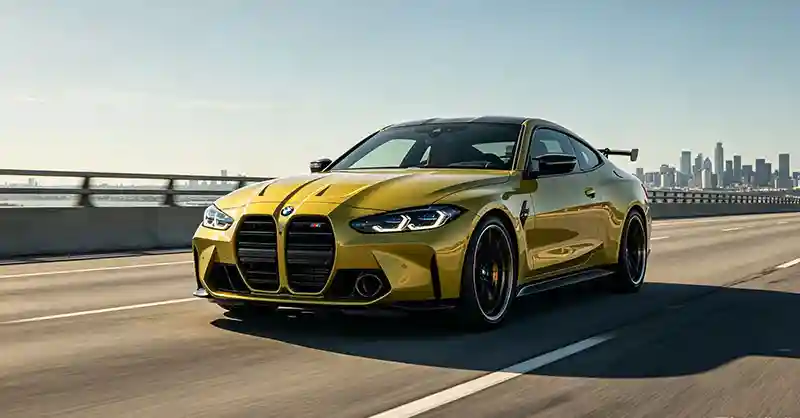
2020–Present BMW M4 G82
The G82 is the second-generation BMW M4.
BMW introduced it in 2020, with production beginning later that year and customer deliveries following in 2021.
The fundamental formula remained recognizable:
- front-engine layout;
- inline-six engine;
- twin turbochargers;
- rear-wheel-drive architecture;
- two-door coupe;
- motorsport-inspired chassis;
- extensive use of lightweight materials.
But almost every part of the formula became more advanced.
BMW S58 Engine: The Heart of the G82 M4
The biggest mechanical change was the move from the S55 to the S58.
The S58 remained a 3.0-liter twin-turbo inline-six, but it was developed as a newer and more robust high-performance engine for BMW M.
Early G82 M4 versions were available in different output levels.
The standard M4 produced approximately 473 hp, while the M4 Competition produced around 503 hp, depending on market specification.
BMW subsequently expanded the lineup with M xDrive and higher-performance derivatives.
The M xDrive Competition model originally produced 510 hp, with 0–100 km/h acceleration in 3.5 seconds.
The latest updated M4 Competition xDrive increased output further to 530 hp and retained the 3.0-liter M TwinPower Turbo inline-six. BMW lists a 0–100 km/h time of 3.5 seconds for the current Competition xDrive coupe.
This means that across the two generations, the M4’s development can be summarized simply:
F82 S55 → G82 S58
and
approximately 425 hp → up to 530 hp
But horsepower is only one part of the story.
BMW M4 xDrive: When All-Wheel Drive Joined the M4
Perhaps the most controversial technical change in the G82 generation was the introduction of M xDrive.
For decades, the classic M3/M4 formula emphasized rear-wheel drive.
BMW decided that the new generation could benefit from an intelligent all-wheel-drive system without abandoning the rear-biased character expected from an M car.
The M xDrive system introduced multiple drive modes.
BMW describes the system as combining the agility of rear-wheel drive with the traction advantages of all-wheel drive. Drivers can select:
- 4WD
- 4WD Sport
- 2WD, when DSC is switched off
The system works together with the Active M Differential.
This changed the M4’s performance philosophy.
The rear-wheel-drive M4 remained the purist choice.
The M4 Competition xDrive became the acceleration-focused choice.
And importantly, BMW did not simply add conventional all-wheel drive. The M xDrive system was engineered specifically around the driving characteristics expected from BMW M.
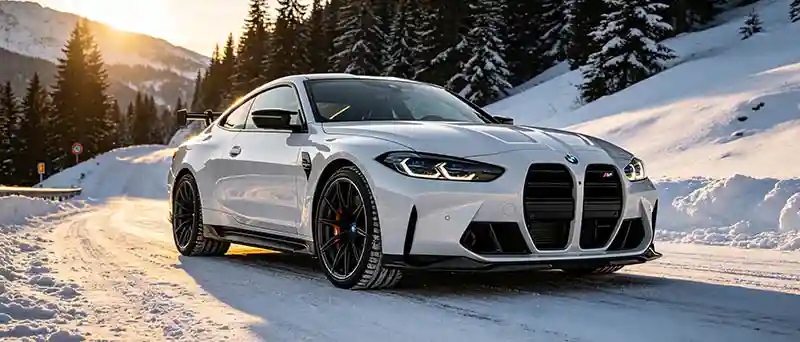
G82 M4 Manual vs Automatic
One aspect that separates different G82 M4 configurations is the transmission.
BMW retained a six-speed manual transmission for selected rear-wheel-drive M4 models.
The Competition models use an eight-speed M Steptronic transmission with Drivelogic.
This creates an interesting split within the G82 lineup.
Manual M4
The manual M4 prioritizes:
- driver involvement;
- mechanical interaction;
- rear-wheel-drive behavior;
- traditional M-car character.
M4 Competition
The Competition focuses more strongly on:
- acceleration;
- shifting speed;
- power delivery;
- track performance;
- electronic control.
M4 Competition xDrive
The xDrive version adds maximum traction and is currently one of the quickest ways to experience the M4 platform in road-going form.
This means that asking “Which BMW M4 is the fastest?” is not enough.
A better question is:
Which BMW M4 configuration best matches the intended driving experience?
The G82 M4 Design Revolution
The engine was not the only thing that changed.
The G82 M4 introduced one of the most controversial front-end designs in modern BMW history.
The most obvious feature was the large vertical kidney grille.
Whether enthusiasts loved or hated the design, it made the G82 immediately recognizable.
Compared with the F82, the G82 had:
- a much larger front grille;
- wider bodywork;
- sharper aerodynamic surfaces;
- more pronounced wheel arches;
- more sculpted side sections;
- larger air intakes;
- aggressive rear diffuser treatment;
- quad exhaust outlets;
- extensive M-specific detailing.
BMW also integrated aerodynamic development much more deeply into the body design.
The G82 was not simply a 4 Series with larger bumpers.
The body, cooling system, suspension, braking system and aerodynamic package were engineered around M performance.
Carbon Fiber in the BMW M4 Evolution
One of the most important themes across modern M4 development is the increasing use of carbon fiber reinforced plastic (CFRP).
The F82 already demonstrated the value of carbon fiber through its carbon-fiber roof.
The G82 took that philosophy further.
Depending on specification, the M4 can incorporate carbon fiber into areas such as:
- roof;
- exterior aerodynamic components;
- mirror elements;
- interior trim;
- bucket seats;
- structural components;
- special-edition body panels.
BMW’s current M4 documentation specifically identifies the CFRP roof as standard equipment on the M4 Coupe, helping reduce weight and lower the vehicle’s center of gravity.
This is particularly relevant when discussing aftermarket BMW M4 components.
Carbon fiber is not only about visual appearance.
For performance applications, the material can provide a combination of:
low mass + high stiffness + complex aerodynamic shaping + premium surface quality.
That is why carbon fiber has become closely associated with modern M4 modification culture.
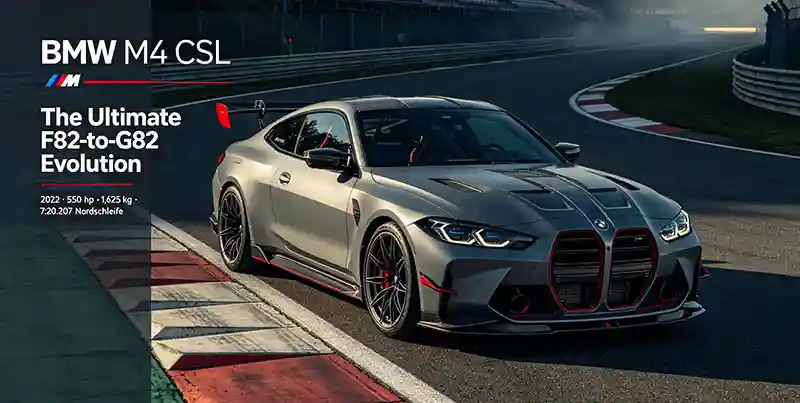
BMW M4 CSL: The Ultimate F82-to-G82 Evolution
2022 BMW M4 CSL
The BMW M4 CSL represents one of the most important milestones in the modern M4 evolution.
BMW revived the historic CSL name for the G82 generation in 2022.
CSL stands for Competition Sport Lightweight, and the philosophy is exactly what the name suggests: reduce weight while increasing performance.
The M4 CSL received a more powerful version of the S58 engine producing:
550 hp and 650 Nm.
BMW lists:
- 550 hp;
- 0–100 km/h in 3.7 seconds;
- approximately 1,625 kg DIN kerb weight;
- two-seat configuration;
- M Carbon full bucket seats;
- track-specific tires.
The model was also limited to 1,000 units.
The M4 CSL therefore wasn’t simply a more powerful M4 Competition.
BMW changed the philosophy of the entire car.
Weight reduction included areas such as:
- seats;
- center console;
- carbon-fiber body components;
- acoustic insulation;
- rear seating;
- lightweight construction details.
The result was a vehicle that prioritized circuit performance much more aggressively than the standard M4.
BMW’s M4 CSL also achieved a Nürburgring Nordschleife lap time of 7:20.207, according to BMW’s own documentation.
This illustrates how far the M4 had evolved in less than a decade.
The first F82 M4 was already a serious performance coupe.
The G82 M4 CSL transformed that platform into a dedicated high-performance road-legal machine.
BMW M4 CS: The Modern Performance Sweet Spot
2024 BMW M4 CS
The BMW M4 CS sits between the regular M4 Competition and the extreme M4 CSL.
BMW introduced the G82 M4 CS in 2024.
The formula was relatively straightforward:
CSL-level power + four-seat practicality + M xDrive + road usability.
The M4 CS produces:
- 550 hp
- 650 Nm
- 0–100 km/h in 3.4 seconds
- 302 km/h top speed
- M xDrive all-wheel drive
BMW also fitted model-specific carbon components and M Carbon bucket seats.
This positioning makes the CS particularly interesting.
The CSL is the lightweight purist.
The Competition xDrive is the high-performance daily driver.
The CS sits between them.
It provides much of the CSL’s engine performance while retaining four seats and greater everyday usability.
BMW reported an official Nürburgring Nordschleife lap time of 7:21.989 for the M4 CS.
Why the M4 CS Matters to the BMW M4 Evolution
The CS demonstrates how BMW’s M4 strategy has become more sophisticated.
In the early F82 generation, BMW’s performance hierarchy was relatively simple.
You had:
M4 → Competition → CS/GTS
The G82 generation created a much broader performance ecosystem:
M4 → Competition → Competition xDrive → CS → CSL
Each version targets a slightly different customer.
That is one of the biggest differences between the first and second generations.
2024 BMW M4 Update: More Power, New Details
BMW updated the G82/G83 M4 for the 2025 model-year era, with production beginning in March 2024.
The update brought several changes to both performance and design.
The most significant powertrain change was the increase in output for the M4 Competition with M xDrive.
Power increased to:
530 hp
BMW also introduced updated:
- headlights;
- laser rear lights;
- forged wheels;
- interior trim;
- steering wheel;
- infotainment technology;
- BMW Operating System 8.5.
The updated M4 Competition xDrive retained its 3.0-liter twin-turbo inline-six and achieved 0–100 km/h in 3.5 seconds.
The standard M4 remained available with 480 hp, while the rear-wheel-drive Competition model produced 510 hp.
So the current G82 family can be broadly understood as three main performance levels:
M4
480 hp + rear-wheel drive + manual transmission available
M4 Competition
510 hp + rear-wheel drive + 8-speed automatic
M4 Competition xDrive
530 hp + M xDrive + 8-speed automatic
This is one of the clearest examples of how the M4 has evolved from a single performance model into an entire performance range.
BMW M4 F82 vs G82: What Actually Changed?
The easiest way to understand the BMW M4 evolution is to compare the two generations directly.
| Feature | F82 M4 | G82 M4 |
|---|---|---|
| Generation | First | Second |
| Introduction | 2014 | 2020 |
| Engine | S55 | S58 |
| Displacement | 3.0L | 3.0L |
| Configuration | Twin-turbo inline-six | Twin-turbo inline-six |
| Standard output | ~425 hp | 473–480 hp depending on model year/spec |
| Competition output | Up to ~450+ hp | Up to 530 hp |
| High-performance derivative | GTS / CS | CS / CSL |
| Manual transmission | Available | Available on selected RWD models |
| AWD | Not available | M xDrive available |
| Carbon roof | Yes | Yes |
| Carbon-fiber usage | Significant | More extensive |
| Body architecture | F32/F82 family | G22/G82 family |
| Convertible | F83 | G83 |
| Design language | Traditional BMW coupe | More aggressive and angular |
| Track-focused flagship | M4 GTS | M4 CSL |
| Current top special edition | — | M4 CS / CSL |
The evolution is therefore not simply:
425 hp → 530 hp
It is:
S55 → S58
RWD-only → RWD + M xDrive
standard performance coupe → multi-level performance family
carbon roof → broader CFRP integration
GTS → CSL/CS
F82 design language → G82 design language
That is the real BMW M4 evolution.
BMW M4 Generations: What Comes Next?
The current BMW M4 family continues to be based around the G82/G83 generation. BMW’s current M lineup still lists the M4 Coupe, M4 Competition Coupe and M4 Competition Convertible among its high-performance models.
That means the G82 generation has become a much longer and more diverse chapter than the original F82.
Rather than simply replacing the previous M4, BMW has used the G82 platform as a foundation for multiple interpretations:
- manual rear-wheel-drive M4;
- Competition rear-wheel-drive M4;
- Competition xDrive;
- M4 CSL;
- M4 CS;
- Coupe;
- Convertible.
This approach gives the modern M4 a much wider performance range than its predecessor.
The Complete BMW M4 Evolution in One Timeline
For a quick reference, the BMW M4 story can be summarized as follows:
2014 — F82 BMW M4
The M4 name officially debuts.
The coupe is separated from the M3 name and receives the S55 3.0-liter twin-turbo inline-six.
2014 — F83 BMW M4 Convertible
BMW introduces the convertible version under the M4 name.
2016 — BMW M4 GTS
BMW pushes the F82 platform toward track performance with 500 hp, water injection, lightweight construction and extensive aerodynamic upgrades.
2017 — BMW M4 CS
The F82 receives a 460-hp limited-performance version positioned between the standard M4 and GTS.
2020 — G82 BMW M4
The second-generation M4 arrives with the new S58 engine and a completely redesigned body.
2021 — G83 BMW M4 Convertible
The second-generation convertible joins the lineup, now using a soft-top configuration and later becoming available with M xDrive.
2021 — M4 Competition xDrive
BMW introduces M xDrive for the M4 Competition, combining all-wheel-drive traction with M-specific rear-biased dynamics and a 510-hp engine.
2022 — BMW M4 CSL
The lightweight flagship arrives with 550 hp, rear-wheel drive, two seats and extensive weight reduction.
2024 — Updated BMW M4
BMW refreshes the G82/G83 and increases M4 Competition xDrive output to 530 hp.
2024 — BMW M4 CS
The 550-hp M4 CS combines CSL-inspired performance with four-seat practicality and M xDrive.
What Is the Biggest Change in BMW M4 Evolution?
If you look only at horsepower, the answer appears obvious.
The M4 became more powerful.
But that isn’t actually the most important change.
The biggest change is that BMW transformed the M4 from a single high-performance coupe into a broad performance platform.
The F82 established the modern M4 formula:
Turbocharged inline-six + rear-wheel drive + lightweight construction + aggressive chassis tuning.
The G82 expanded that formula:
S58 + RWD + M xDrive + advanced electronics + extensive carbon fiber + multiple performance levels.
And the CSL and CS showed that BMW could push the same basic architecture in completely different directions.
The result is a much broader M4 family than the original car.
BMW M4 Evolution FAQ
How many generations of BMW M4 are there?
The BMW M4 has had two primary generations so far: the first-generation F82/F83, introduced in 2014, and the second-generation G82/G83, introduced in 2020/2021. Within those generations, BMW has produced multiple updated and special-performance variants including Competition, GTS, CS and CSL models.
What was the first BMW M4?
The F82 BMW M4 Coupe, introduced in 2014, was the first production vehicle officially named BMW M4. The F83 was its convertible counterpart. BMW separated the coupe and convertible from the M3 naming structure while continuing to use the M3 name for the sedan.
What engine does the F82 BMW M4 use?
The F82 M4 uses the S55 3.0-liter twin-turbocharged inline-six. Early versions produced approximately 425 hp, with later performance variants offering more power.
What engine does the G82 BMW M4 use?
The G82 BMW M4 uses the S58 3.0-liter twin-turbocharged inline-six. Depending on the specific model and model year, output ranges from approximately 473/480 hp for the standard M4 to 530 hp for the current M4 Competition xDrive.
Is the BMW M4 available with all-wheel drive?
Yes. The second-generation BMW M4 introduced M xDrive on Competition models. The system offers different drive modes and can provide rear-wheel-drive operation under appropriate conditions, while the standard M4 remains available with rear-wheel drive.
What is the BMW M4 CSL?
The BMW M4 CSL is a limited-production, lightweight, track-focused version of the G82 M4. It produces 550 hp, uses rear-wheel drive, has a two-seat configuration and incorporates extensive weight-saving measures. BMW limited production to 1,000 units.
What is the BMW M4 CS?
The BMW M4 CS is a high-performance G82 variant positioned between the M4 Competition and M4 CSL. It produces 550 hp, uses M xDrive and combines track-oriented upgrades with four-seat practicality.